Fasteners
Overview
Fastener assembly and designation
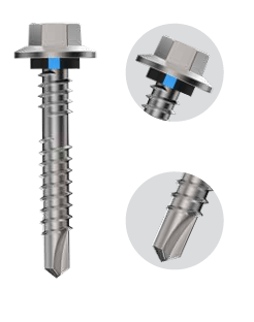
Fixing to Timber & Thin Metal
4.8, 5.4 & 6.2mm Sizes | 25mm- 150mm Lengths
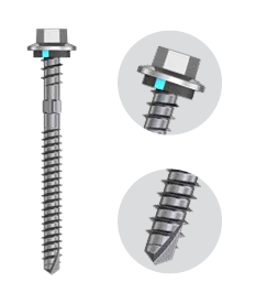
Fixing to Timber
10g, 12g & 14g Sizes | 25mm- 350mm Lengths
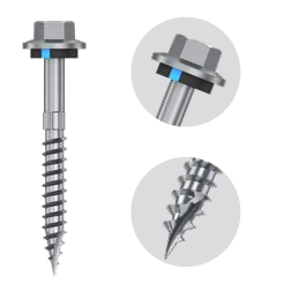
Fixing to Metal
10g, 12g & 14g Sizes | 16mm- 350mm Lengths
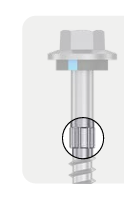
Shank Protector
This design feature enhances corrosion resistance by protecting the fastener shank from severe scratching and scouring that may occur during the installation of metal roofing
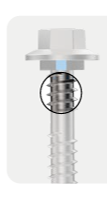
Top Grip
This feature is engineered to maintain consistent pressure between the roofing material and the sealing surface, ensuring a durable watertight seal even under foot traffic and load movement
Designation
For ease of identification all Bremick Self Drilling screws conform to the following designations:
12 - 14 x 55
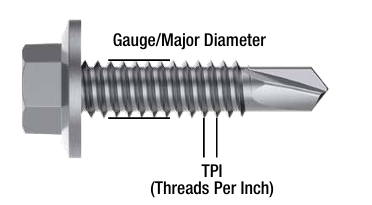
12 = Screw gauge
14 = Threads per inch (TPI)
55 = Screw length in millimetres (mm)
For example, a 12-14 x 55 screw has a 12-gauge diameter, 14 threads per inch, and an overall length of 55mm.
TPI – The TPI of a screw is defined by the number of screw thread in a length of 1 inch (25.4mm)
The screw gauge is determined by the major (outside) thread diameter
Drill Point - Fixing to Metal
The hardened twist-drill style point features drilling flutes for efficient swarf removal, engineered for metal-to-metal fastening and drilling through steel up to 5.5mm thick.
Type 17 Point - Fixing to Timber
Type 17 self-drilling point features a coarse thread extending to the tip for maximum pull-out performance, engineered for fastening roofing sheets to timber while drilling through thin metal up to 0.8mm thick.
Vortex Point - Fixing to Timber & Thin Metal
Vortex Universal Point features advanced thread-to-point technology, engineered for fast, efficient drilling into timber, thin metal battens and steel purlins up to 1.9mm thick.
Material Grades
Material Grades
Bremick® roofing and cladding fasteners are made to AS 3566. Every screw goes through tensile, shear and torsional testing for consistent quality and performance. The right fastener for a site depends on its corrosion environment, which is assessed against the ISO 9223 categories.
Understanding AS 3566
AS 3566 is the primary product standard for self-drilling screws in Australia and New Zealand. It has two parts:
- AS 3566.1 (2002): General requirements and mechanical properties. Covers dimensions, thread geometry, drill point design, heat treatment, hardness, and torsional and tensile strength.
- AS 3566.2 (2025): Corrosion resistance requirements. Covers corrosion protection classes (Class 1–4), accelerated and outdoor exposure testing, coating performance, and sealing washer requirements.
A screw can only claim full AS 3566 compliance if it meets both parts where they apply. Poor-quality or non-compliant fasteners are a common starting point for corrosion on metal roofs. They can lead to staining, water ingress, higher maintenance costs and warranty issues.
Revolution B8® Coating
Revolution B8® is Bremick’s premium coating system and is used across most of the roofing and cladding range. It is rated AS 3566 Class 4 and is warranted for use up to ISO 9223 Category 5 (Very Severe Marine and Very Severe Industrial) environments.
- More than double the corrosion protection of conventional Class 4 coatings in Category 5 environments
- Around eight times harder and more abrasion resistant than conventional Class 4 coatings, so very little coating is lost during drilling. This reduces under-roof microclimate thread corrosion.
- Faster drilling than conventional Class 4 screws
- Even coating coverage, including on complex fastener shapes
- Independently tested at Bremick’s very severe marine outdoor exposure sites under AS 3566.2
- Suitable for use in ACQ and CCA treated timber (Vortex® Plus)
Very Severe Marine (C5) zones have salt in the air but are not directly hit by salt spray. They are typically 100–300m inland on the West and South Coasts of both islands, and 50–200m inland on the East Coast, including the west-facing shores of large harbours.
Extreme Marine zones are typically 0–150m from the West and South Coasts and 0–75m from the East Coast. Aluminium roofing and cladding is normally used in these zones, and stainless-steel fasteners are recommended.
Stainless Steel
Grade 304: Bremick’s 304 stainless range includes:
- Timber self-drilling screws (Type 17): Flanged hex head, with or without seal, for fixing into timber in highly corrosive environments.
- Bi-metal self-drilling metal screws: Flanged hex head, with or without seal, for fixing to steel.
Grade 316: Commonly called marine grade. Use it where fasteners will be submerged in salt water or directly exposed in the most severe environments. Bremick’s approximate protection life for 316 is 50 years in C3, 40 years in C4 and 30 years in C5.
Top Grip
Top Grip is a secondary thread just under the washer face. As the screw is driven, Top Grip lifts the roofing sheet while the washer presses down. This counteracts any dent made when the screw first penetrates, giving a positive seal and stopping the sheet from riding down. It keeps steady pressure between the sheet and the seal, so the fixing stays watertight under foot traffic and load movement.
On selected Vortex® Plus lengths, a shank protector guards the coating from scratching during installation. The UltraSeal™ washer prevents the washer from spewing out if the screw is overdriven.
Sealing Washers
Bremick roofing screws use a non-conductive EPDM sealing washer under a flanged washer face for a durable, weathertight seal.
For strength properties, see section 2.2.3.1.4 of the Technical Manual.
Washers
Washers
Profiled Washers
Profiled washers are shaped to match the rib of the roofing profile and sit over the ribs. They do two jobs:
- They give an acceptable seal area around the oversized holes drilled in the sheet to allow for thermal expansion (refer Section 2.1.3.4).
- They spread the load at the fastener point when the sheet is used under high loads or long spans, where the load per fastener would otherwise exceed the guidelines for that profile.
The recommended washer components for either or both of these functions are:
- Dimond profiled metal washer: Pressed from 0.95mm Zincalume® or 1.2mm aluminium, and painted for colour match and corrosion resistance if required. Each sheet profile has its own profiled washer.
- EPDM (ethylene propylene diene monomer) seal washer: A round, non-conductive rubber seal that fits all sheet profiles and is used under the profiled washer. Available in 19mm, 25mm, 30mm and 36mm diameters.
For the long-term durability of the Zincalume® substrate, the carbon black fillers in sealing washers and neo seals must contain less than 15% carbon by volume or 25% by weight. All washers and neo seals supplied by Dimond meet this requirement.
Other washer components may be suitable, but they must be checked against the two criteria above.
Cyclonic and Commercial Roofing Assemblies
For high-wind and commercial applications, Bremick supplies pre-assembled fasteners combining a Revolution B8® coated screw, a profiled washer and a 36mm EPDM seal. Two washer styles are available:
- BP98 (large) washer assembly: For medium-rib profiles in commercial roofing and cladding.
- Plumdek® (small) washer assembly: For low-rib trapezoidal profiles in residential and light industrial/commercial roofing and cladding.
Both are available with Vortex® universal point, Type 17 timber point, or self-drilling metal point screws, plain or colour-matched. Cyclone plates are available to suit all roofing profiles and can be supplied in aluminium on request.
Round Washers
Round embossed washers, with the seal built into the washer, are mainly used on wall cladding. They provide:
- An acceptable seal area around the fixing screw to allow for thermal expansion of the sheet when fixed in the cladding pan.
- Load-spreading capability at the fastener point when the cladding is fixed in the pan under high loads.
Bremick’s 25mm aluminium embossed washer (“bra”) assemblies come pre-fitted to Vortex®, Type 17 timber, and self-drilling metal screws, all with Revolution B8® coating.
Polycarbonate Washers
For fixing polycarbonate sheeting, Bremick supplies 26mm polycarbonate washer assemblies on Revolution B8® coated screws. Two styles are available:
- Polycarb: Winged point.
- Polycut: Cutter point.
Clips
Decking Clips - Double
Used to secure decking profiles such as Dimondek 300 and Dimondek 400 by pushing the profile down onto it until it clicks into place. The clip is fixed onto the roof structure with either 2 wafer head screws or 2 nails. Refer Section 2.1.4.7 (b) of Technical Manual.
The double clip is designed to fix over the previously laid male under rib and centre rib of the sheet to be laid.
Clip Material
Usually manufactured from either
- As standard unpainted 1.15mm thick coil with galvanised coating to 275 g/m2. Or;
- Coated for increased durability. Nylon coated over galvanised. Colour may vary between Bright blue or light grey depending on supply. During a salt fog test after 2000 hours this coat showed no sign of degradation. Must be used with Aluminum roofing. Or;
- Other material, such as brass clips to suit a copper roof, can be manufactured to customer order. The brass is 1.2mm thick
and is 1/2 hard brass.

Continuous Clips
The innovative continuous metal strip with plastic clip is 1 sheet wide and holds 3 ribs of Dimondek 630 down.
It is interlocked with the previously laid clip, thereby controlling the sheet creep and avoiding an increase in profile cover width.
The Dimondek 630 perimeter clip must always be used over the last rib and clip on the last laid sheet, or on any part of the roof where wind loads exceed 1.6 kPa.
Used only with the Dimondek 630 profile, the clip is screw fixed onto the roof structure after laying and interlocking with the previous clip. This also allows the building paper to be secured, prior to the laying of the roof. The roof profile is then fully pushed down and locked on to the clip and previously laid sheet.
Available as standard: unpainted AZ150g/m2 Zincalume coated steel base with black glass reinforced nylon plastic clip.


Tee Bolt Assembly
Used for fixing Dimondek 300 and Dimondek 400 to the underside of the structural roof members. Typically Universal Beams.
Components
- A stainless-steel Tee bolt; produced from 5mm diameter stainless steel rod welded to form a Tee shape. The longer vertical leg is threaded for approximately 30mm.
- A stainless steel 3mm thick strap x 25mm wide with 6mm diameter hole, used to secure bolt to the roof structure.
- One 5mm diameter stainless steel locking nut and washer.
- Two neo seals to fit over Tee bolt used to seal between the roofing and strap.